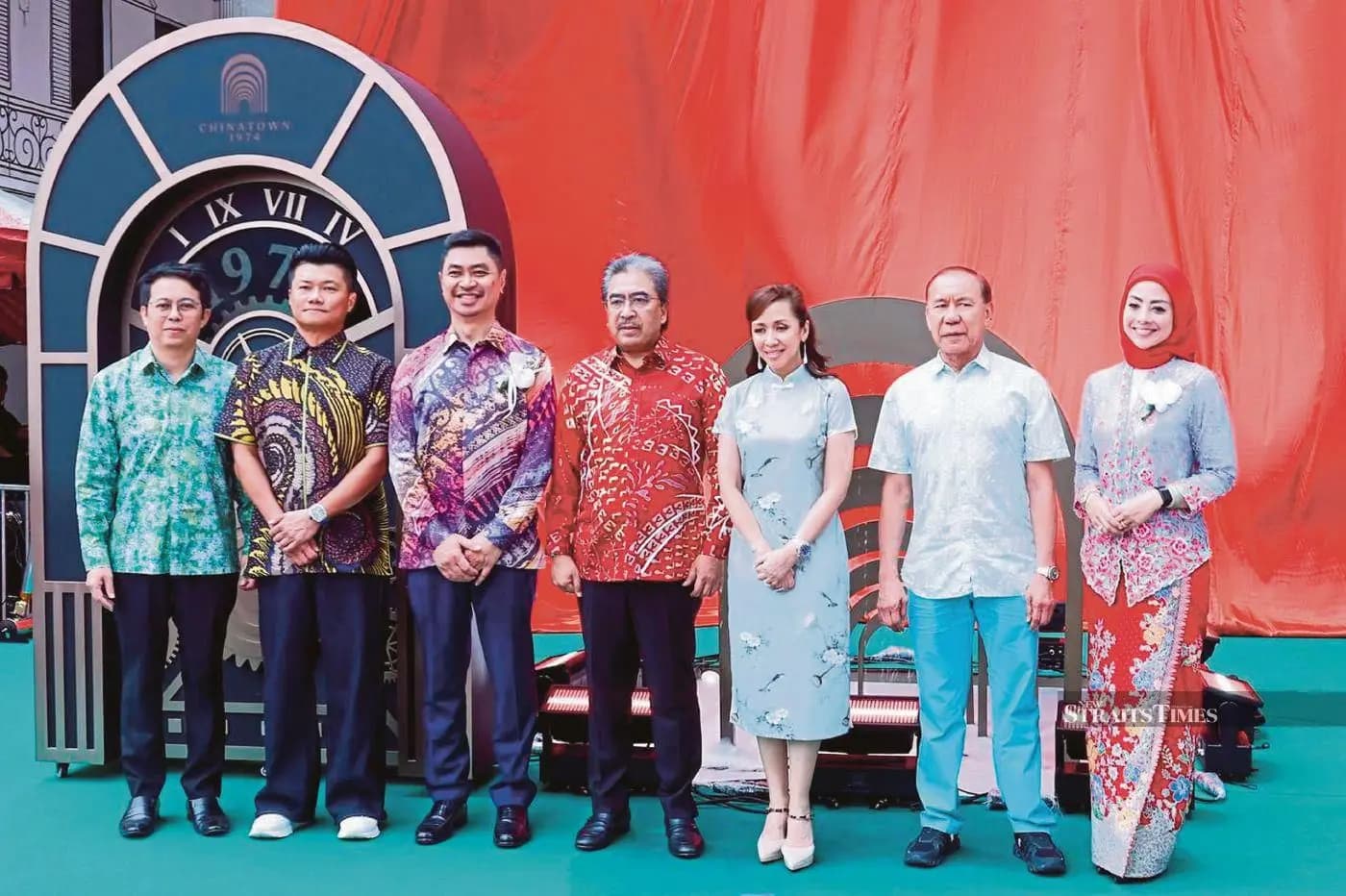
Ageing assets can unlock new economic value, says Johari
KUALA LUMPUR: Ageing and underutilised assets should not be written off as obsolete, as fresh capital, creativity and sound management can unlock new economic value from them.
Investment, Trade and Industry Minister Datuk Seri Johari Abdul Ghani said the ability to repurpose old assets while retaining their heritage and identity could generate stronger economic returns, create business opportunities and revitalise surrounding areas.
"Assets that are no longer in use do not necessarily lose their value simply because they are old or no longer being utilised optimally," he said, according to Berita Harian.
He was speaking at the launch of Chinatown 1974, a redevelopment initiative involving Menara Rezeki and UDA Holdings Bhd aimed at giving a new lease of life to an ageing building in Kuala Lumpur's historic Chinatown district.
Johari commended both parties for recognising the potential of an old asset and investing in its transformation, saying such initiatives demonstrated how private-sector capital and entrepreneurship could revive underutilised properties.
He said investors equipped with vision, capital, creativity and effective management could turn ageing assets into productive economic assets while preserving the character of historic areas.
"We want to see greater economic returns from this area, local businesses grow and existing assets are put to the best possible use. We have many old areas with their own stories, heritage and identity. The question is how we can revive these areas without taking away their original character and identity," he said.
Johari said the value of an investment should also be measured by its wider economic and community impact, rather than solely by the capital committed or the value of the development.
In an Instagram post, he said projects such as Chinatown 1974 could attract more visitors, create jobs and business opportunities, and generate spillover benefits for entrepreneurs, suppliers and businesses in the surrounding area.
The initiative could also strengthen Kuala Lumpur's tourism appeal as Malaysia steps up efforts under the Visit Malaysia programme for 2026 and 2027.
"As the Member of Parliament for Titiwangsa, I welcome efforts to rejuvenate Kuala Lumpur's historic areas while preserving their unique identity and soul," Johari said.
The redevelopment of Chinatown in 1974 highlights the growing potential of adaptive reuse as a means of revitalising ageing urban assets, combining commercial regeneration with heritage preservation and broader economic activity.
Olive Tree Property Consultant founder and chief executive officer Samuel Tan said ageing buildings in prime urban locations are emerging as potential redevelopment opportunities as property owners seek to unlock value from underutilised assets without necessarily starting from scratch.
The strategy is gaining relevance in established city centres where land is scarce, redevelopment costs are high and older properties can still benefit from strong locations, transport links and established commercial catchments, he said.
Tan said property owners needed to look beyond a building's age and assess the value of its location, existing infrastructure and potential for new uses.
"An ageing building must be given a new purpose. Simply renovating the façade or upgrading the interiors may not be enough if the property does not have a clear commercial proposition or cannot attract sustainable footfall.
"The question should not be whether an old building can be saved, but what it can become. The new use must be commercially viable and relevant to its location, surrounding community and target market," Tan told NST Property.
He said adaptive reuse could be particularly relevant in Kuala Lumpur, where older commercial properties are often located in established districts with mature infrastructure, strong connectivity and longstanding business communities.
"These buildings may be old, but their locations are often irreplaceable. You cannot recreate a location that has decades of history, an established catchment and an existing ecosystem of businesses and communities.
"The challenge is to unlock that inherent value and match it with a new use that can generate sustainable income," he said.
He cited Chinatown 1974, an eight-storey destination in Petaling Street that has transformed a previously vacant building into a heritage-inspired commercial, hospitality and lifestyle destination.
Launched on Sept 5, the development combines three food and beverage concepts, a wellness pavilion, a 32-room boutique hotel, a rooftop speciality beverage destination, a durian experience and a mobile Malaysian shaved-ice concept.
The project reinterprets Kuala Lumpur's 1970s through a retro Nanyang heritage concept, with its "MOVING THROUGH TIME" philosophy drawing on the area's multicultural communities, family businesses and traditional commercial activity.
THE VALUE OF REUSE
For property owners, adaptive reuse can offer an opportunity to unlock new value from buildings that already have an established location, structure and surrounding catchment.
Tan said the success of such projects depended on how effectively owners could match an existing asset with a new commercial purpose, particularly in mature urban areas where well-located land is increasingly scarce.
"Adaptive reuse is not simply about renovating an old building. It is about unlocking the value that already exists within the asset and giving it a new commercial purpose.
"Where the location, character and existing structure offer something that cannot be easily replicated through a new development, the investment can create a differentiated product and open up new revenue opportunities," he said.
Tan said owners should assess the potential customer base, tenant mix, footfall and revenue streams when determining how an ageing property could be repositioned.
Chinatown 1974, for example, brings together food and beverage, wellness, hospitality and rooftop experiences within a single property, creating multiple reasons for visitors to enter and spend time at the development.
Its F&B offerings are complemented by The Seven Stars Hotel, which provides 32 boutique rooms, while the rooftop component creates an additional destination with views of Kuala Lumpur's skyline, including the Merdeka 118 landmark.
Tan said a diversified mix of uses could help maximise the potential of an existing building by generating activity across different parts of the property and at different times of the day.
"Mixed-use repositioning can be effective because different components attract different groups of people and generate activity at different times.
"The key is to create a strong ecosystem where the individual components complement one another and collectively strengthen the destination," he said.
Beyond the individual property, successful adaptive reuse can also create wider benefits for the surrounding commercial district.
"When you bring new life into an old building, the impact can extend well beyond the property itself. More visitors can translate into greater business for neighbouring shops, food operators and service providers.
"If more underutilised buildings are successfully revitalised, the cumulative effect can help regenerate an entire precinct and strengthen its overall commercial appeal," he said.
Tan said the opportunity extended beyond heritage buildings to a wide range of ageing properties, including traditional shophouses, former offices, warehouses and commercial buildings that could be repositioned for changing market needs.
"There are many older buildings in Kuala Lumpur and other major cities that may no longer be suitable for their original use. That does not mean they have reached the end of their economic life.
"With the right vision and positioning, an old office building, shophouse, warehouse or commercial property can be transformed into hospitality, lifestyle, cultural, wellness or experiential spaces," he said.
As the property market evolves, Tan said adaptive reuse could give owners greater flexibility in managing ageing assets, providing an alternative to conventional redevelopment while retaining the advantages of established locations.
"Buildings, like businesses, have life cycles. When an asset is no longer performing, owners have to ask how they can reposition it to meet changing market demand.
"Adaptive reuse provides an opportunity to give an existing asset a new purpose, create fresh income streams and contribute to the renewal of the surrounding area," he said.
Tan said for Kuala Lumpur's mature commercial districts, that could turn ageing buildings from underutilised assets into catalysts for a new cycle of investment, activity and growth.
Sumber diterbitkan pada: 7 Sep 2026, 6:53 AM
FindHouse diterbitkan pada: 28 Okt 2026, 12:12 PM